

Choosing Your Academic Pathway
In Europe, there is no such thing as an “undecided” or “undeclared” major. In fact, the American style “major” and “minor” is highly unusual in Europe. Across Europe, bachelor’s degrees prioritize in-depth study of a single subject. So rather than declaring a major and minor, students apply directly to a study program (e.g., Bachelor of Law or Bachelor of Social Sciences) and begin studying that subject from day one. This is why it is essential to already know what you would like to study before applying to a university in Europe.

The library at Trinity College Dublin.
So, you’ve decided to attend university, congrats! Now it’s time to begin contemplating universities to apply to and subject areas to study. Choosing your academic pathway may feel like a daunting task, whether it’s because the options seem endless and you’re not sure where to begin, or maybe you feel torn between two subject areas and aren’t sure how to decide. Hopefully, this post can help give you the confidence boost needed to get started on choosing your academic pathway.

Skola’s newest advisor specializing in academic pathways for undergrad students and STEM studies.
Hi, my name is Carson, and I’m one of Skola’s academic advisors here to help you navigate your higher education journey abroad. I’ve always loved working with students in non-traditional capacities, from outdoor educator to program coordinator, international trip leader, and yes, academic advisor. Coaching young adults, assisting students in setting goals, and guiding students through the higher education labyrinth have become passions of mine throughout my career.
Now that we’ve formally met, let’s get started on choosing your academic pathway abroad. Personally, I’m a visual learner, so I like to write things down to compare everything and really see what’s most suitable for my needs. Heading into this exercise, I strongly encourage you to write down the answers to the questions below, as well as any other important desires, as it will make everything easier for you to stay organized and remember what you’ve already thought about.
When choosing a university, start by making a list of your wants. You may be wondering what I mean by “wants”; I mean anything that you believe would give you the best educational setting for your learning and daily life. Below are a few questions to consider when deciding which universities to apply to:
What do you want out of your university experience?
Are you looking for a large school with endless clubs, big course sizes, and loads of people to meet, or are you looking for a smaller university with tight-knit groups of people and small course sizes where the professors know everyone’s names?
Are you keen to be in a big city where there’s always something to do and new places to explore every weekend, or are you looking for a chill, small-town vibe?
Would you like to be close to home or as far away as humanly possible?
Is a program that allows you to take a semester abroad or participate in Erasmus important?
Remember that location is vital, especially for international students. However, it is also a more challenging question to answer as an international student than for local students who are more familiar with different regions across Europe.







Moving on to picking a subject area. Aim to find an intersection between your interests, what you’re good at, and what you’d like to be good at. If you are certain of a career choice, immediately start researching programs that lead to that career pathway. If you aren’t sure, then begin by making a list to help you narrow down the subject areas, keeping in mind that although you get a degree in an area of study, there are tons of career fields you can enter. Your degree serves as a jumping-off point, giving you strong foundational knowledge and expertise in that field.
Once you’ve narrowed down your interests, start looking at universities that offer programs in the subject area(s) you’d like to study. Be sure to cross-reference your list of university wants with the programs offered to ensure they align with your academic and career goals.
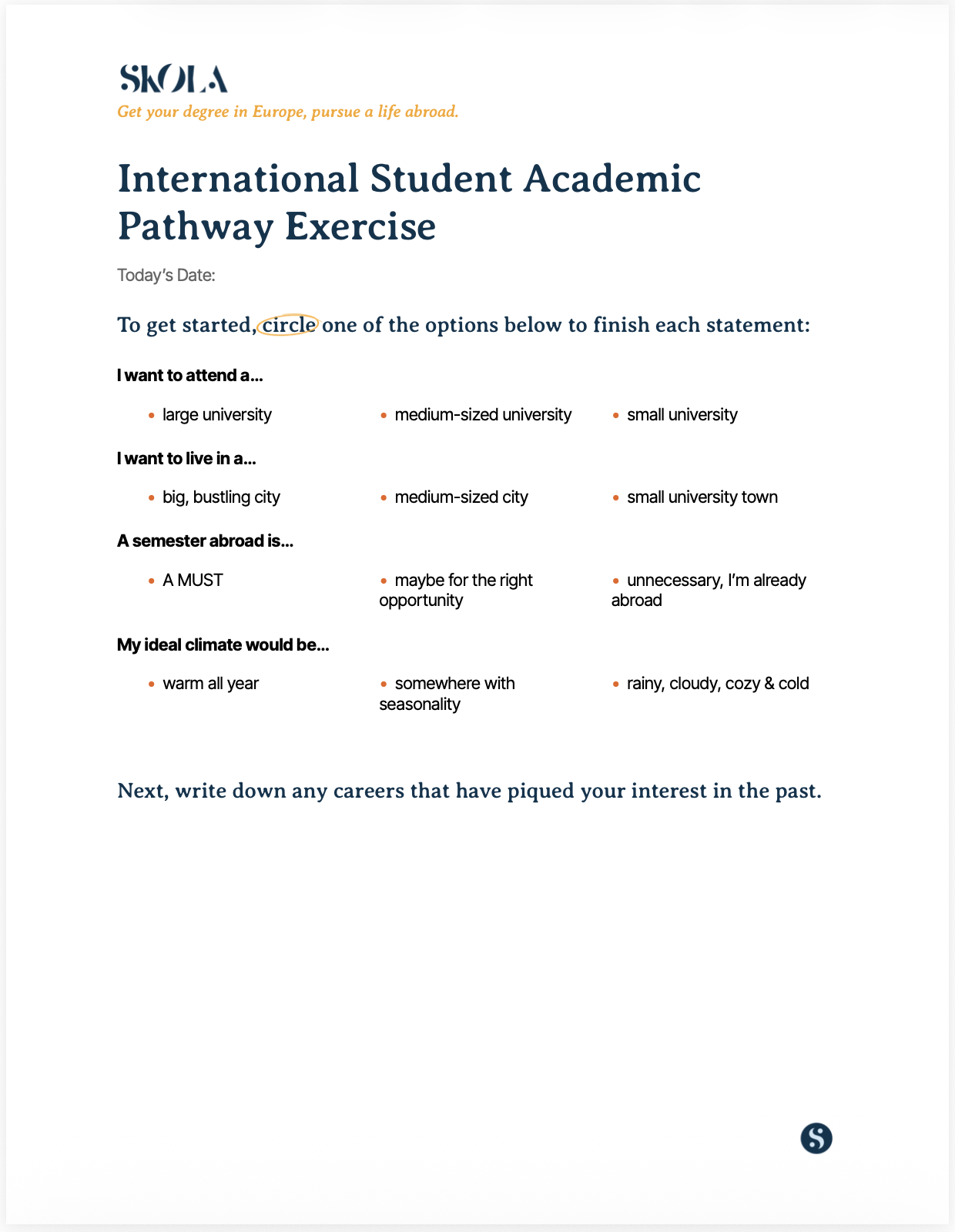
Download a Free Academic Pathways Worksheet
Pro Tip: Don’t be afraid to reach out to the schools and programs you’re interested in to ensure you have the full picture. Some universities even offer student ambassadors, meaning you can ask a real student about their experiences in the program.
The last tidbit I’ll mention before you fall in love with a program is to check the tuition cost for each program you are interested in and write that down with your notes. If you see the cost and feel discouraged, don’t immediately shut down the idea of pursuing that program. Instead, do your due diligence by researching your financial options such as scholarships, fellowships, and grants. Although European education is known for being more affordable, and it is often true compared to American college tuition costs, you always want to be prepared and realistic when it comes to finances.
Hopefully, this helps get you started. Wishing you all the luck in your academic endeavors!

Meet with Carson
In need of guidance with choosing an academic pathway? Book a session with Carson and discover your options.
